oder Titel:
Laboratorium Romanisticae Virtualis (LaRoVi), um den Preis der besthenden Gliederung
soviel Latein versteht jeder (by force of English)
auch (nicht nur) Englisch (vs. Auflage de Gruyter [=dG])
#im Lichte der bestehenden ITG-Umgebung eine ziemlich leblose Initiative (Schöch): http://deutscher-romanistenverband.de/der-drv/ag-digitale-romanistik/#
starke Synergien mit dem bei uns Existierenden (und Geplanten) - ?Einsatz der BA DH-Ling Studierenden?
finanzielle Unterstützung von dG (ca. 5000 €, nach Bem. eines Reihenherausgebers): eher gering, dafür eingesetzt, dass die KiT-Möglichkeiten auf Papierniveau heruntergeregelt werden...
Voranschlag der Vorfinanzierung eines Bandes bei dG angeblich 18 T€
dG erreicht manche, aber erzeugt bei Anderen sicherlich auch Widerstände (Schöch?)
1. Three terms
This manual is about Digital Romance Humanities - neither linguistics, nor philology. The title is thus programmatic, but none of the three combined terms is self-evident. Some explanation is given in the following brief outline, according to a specific conception of the concerned academic matter, its tradition and perspective.
1.1. Humanities
The academic disciplines based on the study of (older) literature and the corresponding languages, e.g. those which developed from Latin, arose during the 19. century with the upcoming of historism. They took the name of 'philologies' which is conserved, with some national differences, up to today at the formal level of universitary institutes and scholars' associations. In research, the matters split up to at least two subdisciplines, interested either in literature or in language, and both very differentiated in itself with regard to their theories methods and contents.
By digitalisation - a covering term which is to be defined later on - the situation of research has changed substantially for the very simple reason that scientific work is based upon data which require similar procedures of codifying, structuring and storing and which afford similar forms of analyse and presentation. For instance a literary text available in a tagged virtual version is without any doubt not only fruitful for literary scholars but can also be very useful for a linguist, more precisely: for linguists with quite different interests, in syntax, semantics, lexicography, historical pragmatics etc. Thus, the gap between subdisciplines may be easily bridged (see Krefeld 2018c). The result, however, might not necessarily be a reborn philology, because data which are not extracted from texts can be important as well for literary or linguistic interpretation, such as data from demography, history, history of arts, archaelogy etc. It is obvious now, that the new, digital, concept of humanities corresponds very well to this more or less open merge of heterogenous data.
1.2. Romance
The shift from philology to humanities in the sketched extended sense concerns equally the understanding of Romance, which is used only for languages and older literature, but never for the corresponding states (Portugal, Spain, France, Italy, Romania and partly Belgium and Switzerland) or the various facettes of their cultures. So we might define Digital Romance Humanities as data based research about texts/discourses in romance languages and about corresponding extraction of linguistic regularities and systems - in a way that subsidiary non linguistic data from other disciplines may generally be integrated.
1.3. Digital
Digitalization involves electronical devices, but it is not sufficient to reduce it to mere computing. We have to distinguish several levels, from elementary binary code up to structured electronical text (see Lücke 2017). At the moment it will be difficult to avoid completely the inclusion of data on a merely basic level of digitalization with a lack of structurization in terms of logic such as PDF-Documents. But the Digital Humanities should try to do so and aim at using exclusively structured data. At this metadata standards play an important role, but so far none of the existing standards has reached common establishment. Therefore, for the time being - but also in the future as standards mostly do not fit a hundred percent to the demands of individual projects and therefore often are looked upon as obstructive - the best choice is the use of a concept of interfaces that allow to transform project specific structured data to any other structure or standards respectively.
Digital Humanities have obviously forerunners, but the expression itself was born only under the horizon of web 2.0 (see Unsworth u.a. 2004) and the use of web technology is actually an important prerequisite for its successful development. The Digital Humanities are, to our opinion, essentially collaborative and the appropriate format of organizing research are web-based online, and basically virtual environments. Obviously, the appropriation of new media opens also new ways of science application, particularly with regard to education (see Pro2F). From the programmatic standpoint we can state now on the one hand that Digital Humanities are not seen as a discipline in its own right, but as a complex framework for established disciplines and on the other hand that the traditional disciplines need to be transferred to this virtual framework in order to benefit from the methodological facilities offered by digitalization and new media. In other words: DRomH are mainly concerned with free access publication of content and collaboration among people interested in this content, whether they are scholars or not .
2. Two purposes
The DRomH-manual serves two purposes.
2.1. Methodological overview
It wants to give an overview on current research that has long term perspectives and might work as a methodological example for the research community. In consideration of the very recent coming up of the label Digital Humanities we will take into account also projects which did not - could not by the time of their emergence - claim the label themselves. This is for instance the case of important lexicographic enterprises. The idea is not to be exhaustive but exemplary. Outstanding projects with innovative power will be selected and invited to present themselves.
2.2. Collaborative Framework
It aims at the realization and the establishment of a usable and comprehensive disciplinary framework according to the FAIR principles (cf. Lücke 2018b). Therefore each project presentation has to delineate the possibilities of opening their projects, in order to integrate add-ons, links etc. proposed by other scholars or, maybe, even by non scholars. And furthermore, continuative projects should be suggested.
That is to say, that the project's most important objective is beyond the manual itself and also beyond print at all: DH do not exclude printing, but printing is nothing but a secondary functionality, online publication always being the first means of choice. It was substantial for traditional research because it represented the condition for what was called publication, without really being public. The publicity of the few scientific libraries should be called privacy of an elite living close to these instituions.
At the moment the mostly concerned matters in the field of digital romance humanities are those shown in the following figure:
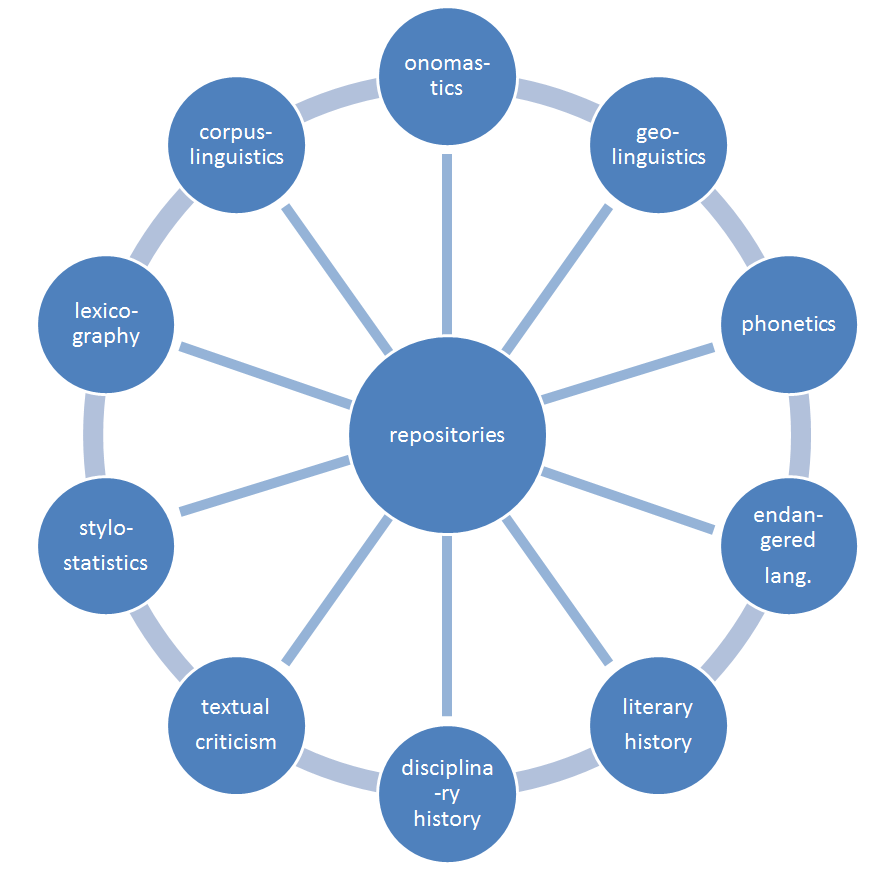
Mostly concerned matters
The projects presented in this manual were selected according to the following criteria:
- at least one of each field identified in the above figure should represented;
- diverse Romance languages are represented;
- the work is web-based and users are not required to install clients;
- the web-site is non commercial; therefore some well done and well known sites or services were neglected, e.g. Frantext;
- the specific approach is regarded by us to be a model for future research; corresponding tools and code are offered;
- multiple possibilities of complementary and further research are offered.
2.3. Selected projects
| Corpus-linguistics | CORDE: a representative diachronic corpus for the formation of Spanish pluricentrism, which separate filtering options |
| CREA :a representative synchronic corpus for pluricentric Spanish, which separate filtering options | |
| CoLiTec: an open access corpus based exclusively on data extracted from the web itself; the corpus is continuosly adapted and augmented | |
| Stark 2016-2018: a multilingual corpus (deu, fra, ita, roh) of language used in a very popular instant messaging service | |
| CLIPS: methodologically innovative corpus of audio files, documenting the urban italian varieties of the most important cities | |
| Onomastics | ortsnamen.ch: multilingual project of crucial importance for neighbouring areas in France, Italy, Austria and Germany |
| Geolinguistics | THESOC: illustrates the challenge of structuring retro digitized data |
| ALIQUOT: atlas of diatopic variation in the lexic of every day standard language (not dialect), completely based on crowdsourcing data, elicitated with short questionaries in annual campaigns | |
| VA: comprehensive virtual research environment including an interlingual atlas of dialect variation in a multilingual region (oci, fra, ita, rhaeto-r., deu, slv); retro-digitized data combined with crowdsourcing data | |
| Endangered languages | Lia Rumantscha: example of a multidimensional initiative of language promotion comprising standardization (Pledari grond), education, literature, historic documentation, use of new media |
| Phonetics | PFC/ FLOraL, Pro2F innovative application of recent research to language acquisition; |
| comparative project based on audio files from por, span, cat, oci, fra friu ita srd ron IARI | |
| Lexicography | synchronic, exhaustive vocabulary of present-day language, each token used in an article is linked to corresponding type: (DLE); similar: (dexonline) |
| synchronic, multilingual conception (por, spa, fra, ita) with crowd collaboration (forum): LEO | |
| diachronic, representative dictionary of older varieties, corpus based: TLIO | |
| diachronic, exhaustive etymologic dictionary of standard and national dialects: eFEW | |
| Stylo-statistics | CLIGS: ambitiuos attempt of new founding literary studies (French theatre, Spanish novel) in quantitative analysis |
| Textual criticism | DDP : unique research environment for an author of fundamental importance |
| Literary history | Théâtre classique: representative corpus of French classic theatre |
| Disciplinary History | HSA: annotated edition of the voluminous work of Hugo Schuchardt, one of the leading and ground-breaking linguists in late 19th and early 20th century , Crusca |
3. Road map
#working platform on WordPress LMU (or on the Gruyter website?) for further collaboration beyond the manual#
| 20190730 | invitation to participate | |
| 20200331 | deadline for delivery |
financial support |
| 20200930 | finishing |
4. Authors' Guideline
- How are data stuctured?
- Which tools and methods were/are used for structuring data?
- Do you think connection with analogous data of other projects does make sense and which way of connection do you imagine?
- What is your license policy? Are you willing to give open access to your data?
- What is your opinion about sustainability and reuse of your data? How do you tackle these issues? Who or which institution is in charge regarding these issues?
- Are you provided with private services for data structuring, data management, data storing, hosting etc.?
- How do you manage volatility of data and do you guarantee quotability?
- Do you use existing standards for data encoding and structuring? If so, which?
Bibliographie
- ALF = Davoine, Paule-Annick (2017): Atlas linguistique de la France, par Jules Gilliéron et Edmond Edmont (1902-1910) (Link).
- ALIQUOT = Tosques, Fabio / Castellarin, Michele (2013-): Atlante della lingua italiana quotidiana, Berlin, online (Link).
- ALPI = Fernández-Ordóñez, Inés / Heap, David / Perea, Maria Pilar / Saramago, João / Sousa, Xulio (2016): ALPI-CSIC [www.alpi.csic.es], edición digital de Navarro Tomás, Tomás (dir.), Atlas Lingüístico de la Península Ibérica, Madrid, CSIC (Link).
- AMDV = Tisato, Graziano (Hrsg.) (2014): Multimedia Atlas of Veneto Dialects, Padova (Link).
- BADIP = Bellini, Daniele / Schneider, Stefan (Hrsgg.) (2003-2018): Banca dati dell'italiano parlato, Graz, Karl-Franzens-Universität (Link).
- CLIGS = Schöch, Christoph (Hrsg.) (2014-): Computergestützte literarische Gattungsstilistik (Link).
- CLIPS = Albano Leoni, Federico (Hrsg.) (2007): Corpora e Lessici dell'Italiano Parlato e Scritto, online (Link).
- CoLiTec = CoLiTec: The CoLiTec corpora, Università di Bologna. Sede di Forlí (Link).
- CORDE = Real Academia Española (Hrsg.): Corpus Diacrónico del Español (CORDE), Madrid (Link).
- CoRoLa = Radu, Ion: CoRoLa - Corpus de referință pentru limba română contemporană (Link).
- CREA = Real Academia Española (Hrsg.): Corpus de Referencia del Español Actual (CREA), Madrid (Link).
- DDP = Hollander, Robert / Campbell, Stephen / Marchesi, Simone (Hrsgg.) (2005): Dartmouth Dante Project, Princeton (Link).
- dexonline = Frâncu, Cătălin (2004-2018): dexonline. Dicționare ale limbii române, online (Link).
- DLE = Real Academia Española (Hrsg.) (2017): Diccionario de la lengua española. Edición del Tricentenario , Madrid (Link).
- DTT = Floess, Lydia (Hrsg.) (2014): Il Dizionario toponomastico trentino, Trento (Link).
- Dürscheid/Stark 2011 = Dürscheid, Christa / Stark, Elisabeth (2011): sms4science: An International Corpus-Based Texting Project and the Specific Challenges for Multilingual Switzerland, in: Thurlow, Crispin / Mroczek, Kristine (Hrsgg.), Digital Discourse: Language in the New Media, Oxford, University Press, 299-320.
- eFEW = Buchi, Éva (Hrsg.) (2013): FEW informatisé, Nancy, atilf (Link).
- FEW = von Wartburg, Walther (1948): Französisches Etymologisches Wörterbuch, Tübingen, J. C. B. Mohr.
- FLOraL = Andreassen, Helene N. / Baude, Olivier / Côté, Marie-Hélène / Detey, Sylvai / Eychenne, Julien / Pustka, Elissa / Racine, Isabelle (2017): Phonologie du français contemporain (pfc) : usages, variétés, structure, Elissa Pustka (Université de Vienne) Isabelle Racine ( (Link).
- FRANTEXT = nn., nn. (2016): Base textuelle FRANTEXT, ATILF, Nancy, CNRS, Université de Lorraine (Link).
- HSA = Hurch, Bernhard (Hrsg.) (o.J.): Hugo Schuchardt Archiv, Graz (Link).
- IARI = Prieto, Pilar / Borràs-Comes, Joan / Roseano, Paolo (Hrsgg.) (2010-2014): Interactive Atlas of Romance Intonation, Barcelona, CREA - Universitat Pompeu Fabra (Link).
- Imbs/Quemada 1974 = Imbs, Paul / Quemada, Bernard (Hrsgg.) (1974): Trésor de la langue française, Paris, CNRS.
- Krefeld 2018c = Krefeld, Thomas (2018): Eine neue (digitale) Einheit für ein altes (philologisches) Fach – DromH, in: Korpus im Text (Link).
- LEO = Riethmayer, Hans / Bartel, Elmar (Hrsgg.) (1995-): LEOs Wörterbücher (Link).
- Lücke 2017 = Lücke, Stephan (2017): Digitalisierung, in: 17/1, VerbaAlpina-de (Hrsg.), Methodologie (Link).
- Lücke 2018b = Lücke, Stephan (2018): FAIR-Prinzipien, in: Methodologie, VerbaAlpina-de 18/2 (Link).
- NavigAIS = Tisato, Graziano (2017): NavigAIS. AIS Digital Atlas and Navigation Software, Padua, Istituto di Scienze e Tecnologie della Cognizione (ISTC) - Consiglio Nazionale delle Ricerche (CNR) [Online-Version von Jaberg/Jud, 1928-1940, Sprach- und Sachatlas Italiens und der Südschweiz (AIS)] (Link).
- ortsnamen.ch = Bickel, Hans / Graf, Hannes (Hrsgg.): ortsnamen.ch - Das Portal der schweizerischen Ortsnamenforschung, Zürich (Link).
- PFC = Durand, Jacques / Laks, Bernard / Chantal, Lyche (2002): La phonologie du français contemporain: usages, variétés et structure, in: C. Pusch & W. Raible (éds), Romanistische Korpuslinguistik- Korpora und gesprochene Sprache/Romance Corpus Linguistics – Corpora and Spoken Language, Tübingen, Narr, 93-106.
- Pledari grond = Lia Rumantscha (Hrsg.) (1980-): Pledari grond, Chur (Link).
- Pro2F = Pustka, Elissa (Hrsg.): PRO²F. Pronunciation in Progress, Wien (Link).
- sms4science = Stark, Elisabeth / Ueberwasser, Simone / Ruef, Beni (2014): Swiss SMS Corpus, Zürich, University of Zurich (Link).
- Stark 2016-2018 = Stark, Elisabeth (2016-2018): "What’s up, Switzerland?" (Sinergia: CRSII1_160714), Universität Zürich (Link).
- Stark u.a. 2014 = Stark, Elisabeth / Dürscheid, Christa / Meisner, Charlotte (2014): What’s up Switzerland? WhatsApp-Chats in der Schweiz: Erste Ergebnisse liegen vor [Letzter Zugriff am 06.04.2017] (Link).
- Théâtre classique = Fièvre, Paul (2007): Théâtre classique (Link).
- THESOC = Oliviéri, Michèle / Dalbera, Jean-Philippe (Hrsgg.): Base de données lexicales, Nice (Link).
- TLFi = atilf (1994): Trésor de la Langue Française informatisé, Nancy, Université de Lorraine - CNRS (Link).
- TLIO = Leonardi, Lino: Tesoro della Lingua Italiana delle Origini Il primo dizionario storico dell'italiano antico che nasce direttamente in rete fondato da Pietro G. Beltrami, online (Link).
- Ueberwasser/Stark 2017 = Ueberwasser, Simone / Stark, Elisabeth (2017): What’s up, Switzerland? A corpus-based research project in a multilingual country, in: Linguistik online, vol. 84/5, 105-126.
- Unsworth u.a. 2004 = Unsworth, John / Schreibman, Susan / Siemens, Ray (Hrsgg.) (2004): A Companion to Digital Humanities, Oxford, Blackwell (Link).
- VA = Krefeld, Thomas / Lücke, Stephan u.a. (2017): VerbaAlpina (Link).
- WALS = Dryer, Matthew / Haspelmath, Martin (Hrsgg.) (2013): The World Atlas of Language Structures Online, Leipzig, Max Planck Institute for Evolutionary Anthropology [Accessed on 2018-04-20] (Link).